Did you all love this chapter as much as I did?
Chapter 8 is all about noticing the details in illustrations, and we all know our littles are great at noticing the details!
“Mrs. Pedersen, what’s in your nose?”
“Mrs. Pedersen, your hair is messy today.”
“Mrs. Pedersen, what’s that big red thing on your forehead?”
I’m sure you’ve all heard a version of these “noticings” before, right?
Kids notice so many things in the details of illustrations, that it only makes sense to actually
take the time to point them out and discuss why the illustrator might have chosen to make the details the way he/she did.
The techniques that Katie focuses on in this chapter are:
13. Crafting Details of Expression and Gesture
14. Crafting Physical Details of Characters
15. Revealing Character with Background Details
16.Crafting Details from the World of Nature
17. Showing the Effects of Weather on a Scene
18.Crafting Details from the World of People
19.Using Authentic, Object-Specific Details
20.Creating the Illusion of Motion with Detail
21.Creating the Illusion of Sound with Details
Again, I’m not going to go into detail on each one, just point out a few techniques. Be sure to check out the other blogs that are linked up below for more ideas!
Technique 20: Creating and Illusion of Motion with Detail
I LOVE this one. I think it’s so easy for the littles to use this technique

. Katie talks about showing motion in more ways than just using lines like this little girl did. (She’s playing tag with her brother!). She says that you could use lines of motion, repeated images (of the object moving), or repeated images of a certain body part moving.
She does warn us though, that we have to careful with this technique because pretty soon
everything on their pages will be in motion! They will naturally overuse during their learning, but it’s our job to point out when it is and is not appropriate to show motion in our drawings.
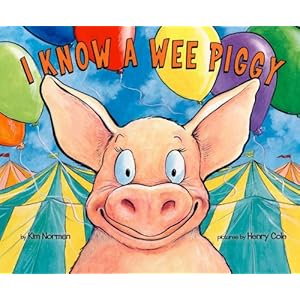
Here’s a couple more examples from the picture book
I Know a Wee Piggy by Kim Norman.
18.Crafting Details from the World of People
In this technique, Katie tells us that using lots of detail brings authenticity to a setting. It makes the pictures “come alive!”
I love the attention to detail that was put into this drawing. She really thought out everything that she had written about. I do this writing/drawing activity after we have read and discussed (yet another) Kevin Henkes book:
This is such a sweet book that had TONS of details from “the world of people.”
Check out these great details – kids could stare at these illustrations forever!


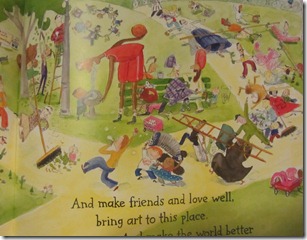
The illustrator, Laura Cornell, has filled the pictures will all different types, shapes, sizes, colors of people. I love it!
17. Showing the Effects of Weather on a Scene
Katie tells us that we can also use weather as a detail on a scene. Up here in the north, we clearly have 4 distinct seasons – although sometimes some seasons are longer (winter) and some are shorter (summer!). Children can experience the change of the trees very distinctly.
This beautiful book

was introduced to me by one of my favorite professors in grad school. She is an amazing artist, and taught us to appreciate the illustrations as well as the words in her children’s literature course. The book does uses both words and pictures so eloquently.
It sounds funny, but it’s a beautiful love story about two pairs of pajamas. If you can find a copy, it is so lovely. I purchased mine from ebay a few years ago.
But take a peek at how the illustrator, Mary Beth Owens, used the weather in her illustrations.
(wind)


(snow-I can almost feel the cold of the snow from the illustration on the left)

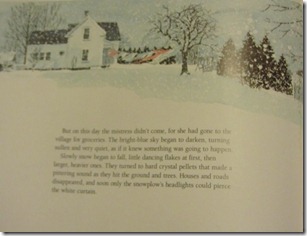


(spring and summer/autumn)

 13. Crafting Details of Expression and Gesture
Kids can read expressions so well (hello, teacher/mom face), we should encourage them to transfer those expressions onto their drawings as well. We all know about books about feelings with great expressions, how about a silly one?
My kiddos love this book:

Just look at their expressions!


Katie says on page 138, “the key for teaching is to bring the natural noticing children do as they people-watching in books to a very conscious level.” She tells us that we should “wonder together” about why a character’s facial expressions are drawn a certain way. We should ask ‘what does the author want us to know based on what the illustrator does in the pictures?’
I bet you are starting to look at illustrations in a whole new way – are you starting to notice some of the techniques that we have pointed out? Many of these books use more than one of the techniques that I’ve pointed out. As you read to your own kiddos this week, see if you can pick out some of the techniques we are reading about and put a sticky note on the illustration. (for you to refer back to!) Leave a comment below with your reflections and a book if you can find one. If you are a blogger, do a quick blog post – it doesn’t have to be detailed

- it could win you $25 in free books from….
Here’s how you enter to win…
Here is how (pick just one)
1.
Followers: Leave your reflections on Chapter 8 in the comment section of my blog...Simple!
or
2.
Bloggers: Blog about chapter 8 and include a link back to this page. Then link your blog post below.
*Remember to only link up if you have blogged about chapter 8. Also, link DIRECTLY to the post, not just your blog URL. I will be deleting links that aren’t related to the book.*
Off we go!